
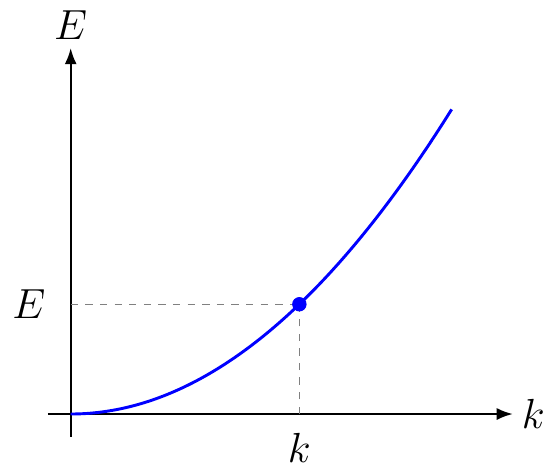
Variables
Description
What is this formula?
The free electron energy formula describes the kinetic energy of an electron moving freely inside a solid without being affected by the crystal lattice potential. It is one of the fundamental equations in solid state physics and forms the basis of the free electron model used in metals.
When to use it
This formula is used when analyzing electron motion in conductive materials, band structures, Fermi surfaces, and electron gas models. It is especially important in quantum mechanics and semiconductor physics.
Example
An electron in a metal has a wave vector magnitude of:
k = 8.0×10^9 1/m
Using:
E = (ℏ²k²)/(2m)
Where:
ℏ = 1.055×10^-34 J·s
m = 9.11×10^-31 kg
Substitution:
E = ((1.055×10^-34)² × (8.0×10^9)²) / (2 × 9.11×10^-31)
Result:
E ≈ 3.91×10^-19 J
Applications
- Free electron gas models
- Metal conductivity analysis
- Quantum mechanics
- Semiconductor physics
- Electronic band structure calculations
- Fermi surface studies