
Variables
Description
What is this formula?
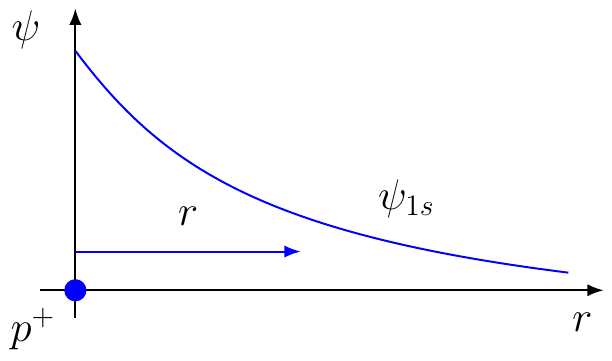
This formula calculates the normalized 1s wavefunction of the hydrogen atom, which describes the electron in its ground state according to quantum mechanics. The wavefunction represents the probability amplitude of finding the electron at a given radial distance from the nucleus.
The square of the wavefunction gives the corresponding probability density. The 1s orbital is spherically symmetric and represents the most stable electronic state of the hydrogen atom, with the highest probability of finding the electron near the Bohr radius.
When to use it
Use this formula when studying the hydrogen atom, atomic orbitals, electron probability distributions, quantum chemistry, and introductory quantum mechanics. It is also useful for understanding the spatial behavior of electrons in hydrogen-like atoms.
Example
Given:
Radial distance = 5.29 × 10^-11 m
Bohr radius = 5.29 × 10^-11 m
Formula:
ψ1s(r) = (1/√(πa0³)) × exp(-r/a0)
Substitution:
ψ1s(r) = (1/√(π × (5.29 × 10^-11)³)) × exp(-(5.29 × 10^-11)/(5.29 × 10^-11))
Result:
ψ1s(r) ≈ 1.71 × 10^15 m^-3/2
This value represents the probability amplitude of finding the electron at the specified distance from the nucleus while it remains in the hydrogen ground state.
Applications
Hydrogen atom modeling
Atomic orbital calculations
Quantum chemistry
Electron probability density analysis
Atomic physics
Spectroscopy
Physics education
Note
The 1s orbital is the lowest-energy atomic orbital and exhibits spherical symmetry about the nucleus. The wavefunction decreases exponentially as the distance from the nucleus increases, indicating that the probability of finding the electron becomes progressively smaller farther from the nucleus. The probability density is obtained by squaring the magnitude of the wavefunction.