
\[p=\frac{\sqrt{\left(M^2-(m_1+m_2)^2\right)\left(M^2-(m_1-m_2)^2\right)}}{2M}\]
Variables
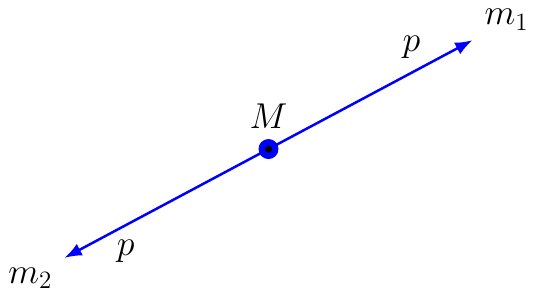
pdecay momentum (kg·m/s)
Mparent particle mass (kg)
m1mass of first daughter particle (kg)
m2mass of second daughter particle (kg)
Description
What is this formula?
The two-body decay momentum formula calculates the momentum of particles produced in a relativistic decay where one parent particle decays into two daughter particles.
When to use it
Use this formula in particle physics when analyzing relativistic decays, collider events, conservation laws, and decay kinematics.
Example
A particle with mass:
M = 5 GeV/c²
decays into:
m1 = 2 GeV/c²
m2 = 1 GeV/c²
Formula:
p = sqrt((M²-(m1+m2)²)*(M²-(m1-m2)²))/(2M)
Substitution:
p = sqrt((25-9)*(25-1))/(10)
Result:
p ≈ 3.10 GeV/c
The daughter particles are produced with momentum approximately equal to 3.10 GeV/c.
Applications
Collider physics, relativistic kinematics, particle decay analysis, detector reconstruction, and high-energy physics experiments.