
\[\lambda=\frac{h}{\sqrt{2\pi mk_B T}}\]
Variables
lambdathermal de Broglie wavelength (m)
hPlanck constant (J·s)
mparticle mass (kg)
kBBoltzmann constant (J/K)
Tabsolute temperature (K)
Description
What is this formula?
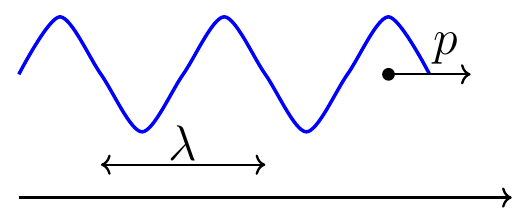
The thermal de Broglie wavelength formula calculates the effective quantum wavelength associated with particles at a given temperature.
When to use it
Use this formula in quantum statistics, chemical physics, condensed matter physics, and thermodynamics when analyzing quantum effects in gases or particle systems.
Example
An electron at temperature:
T = 300 K
Data:
h = 6.626×10^-34 J·s
m = 9.109×10^-31 kg
kB = 1.380649×10^-23 J/K
Formula:
lambda = h/sqrt(2*pi*m*kB*T)
Substitution:
lambda = 6.626×10^-34 / sqrt(2*pi × 9.109×10^-31 × 1.380649×10^-23 × 300)
Result:
lambda ≈ 4.30×10^-9 m
The thermal de Broglie wavelength is approximately 4.30 nm.
Applications
- Quantum gas analysis
- Bose-Einstein condensation
- Semiconductor physics
- Statistical mechanics
- Low-temperature physics