
Variables
Description
What is this formula?
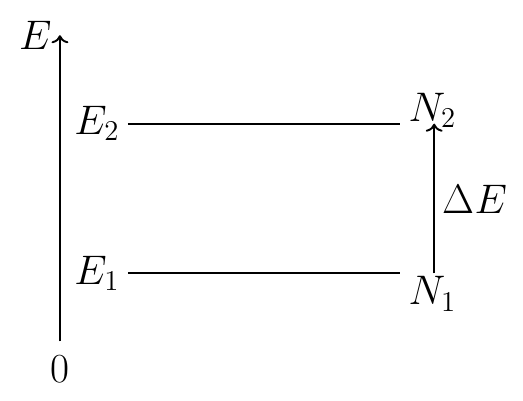
The Boltzmann population ratio formula calculates the relative population of particles occupying two different energy states at thermal equilibrium.
When to use it
Use this formula in statistical mechanics, thermodynamics, spectroscopy, quantum physics, and chemical physics to estimate how particles distribute among energy levels.
Example
Two molecular energy states differ by:
dE = 3.2×10^-21 J
At temperature:
T = 300 K
Using:
kB = 1.380649×10^-23 J/K
Formula:
N2/N1 = e^(-dE/(kB*T))
Substitution:
N2/N1 = e^(-(3.2×10^-21)/(1.380649×10^-23 × 300))
Result:
N2/N1 ≈ 0.462
The higher energy state contains approximately 46.2% of the population of the lower state.
Applications
- Molecular spectroscopy
- Quantum state populations
- Thermal equilibrium analysis
- Chemical kinetics
- Statistical thermodynamics