
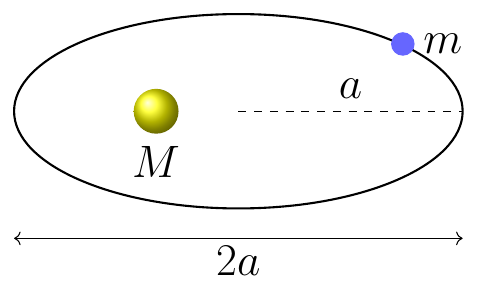
Variables
Description
What is this formula?
This formula calculates the semi-major axis of an orbit using Kepler's third law in Newtonian form. It relates the size of an orbit to the orbital period and the total mass of the two-body system.
When to use it
Use this formula when the orbital period and masses of the two bodies are known and the orbital size needs to be determined.
Example
A satellite orbits Earth once every 90 minutes.
Given:
T=5400 s
G=6.67430×10^-11 m³/kg·s²
M=5.972×10^24 kg
m=1000 kg
Formula:
a=((G*(M+m)*T²)/(4*pi²))^(1/3)
Substitution:
a=((6.67430×10^-11*(5.972×10^24+1000)*(5400)²)/(4*pi²))^(1/3)
Result:
a≈6.65×10^6 m
The satellite's semi-major axis is approximately 6650 km from Earth's center.
Applications
- Satellite orbit design
- Planetary orbit calculation
- Space mission planning
- Binary star analysis
- Celestial mechanics