
Variables
Description
What is this formula?
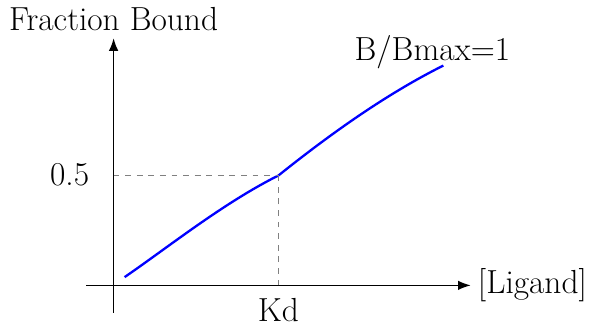
The Fractional Receptor Binding equation calculates the fraction of total receptor binding sites occupied by a ligand at equilibrium.
It expresses receptor occupancy as the ratio between observed binding (B) and maximum possible binding (Bmax). The result ranges from 0 to 1.
This equation is widely used in receptor pharmacology, radioligand binding studies, biochemistry, and drug discovery.
When to use it
Use this equation when:
- Analyzing receptor binding experiments
- Estimating receptor occupancy
- Comparing ligand affinity
- Determining binding saturation
- Studying drug–receptor interactions
Example
Given:
L = 15 nM
Kd = 5 nM
Formula:
B/Bmax = L/(Kd + L)
Substitution:
B/Bmax = 15/(5 + 15)
B/Bmax = 15/20
B/Bmax = 0.75
Result:
75% of the available receptor binding sites are occupied.
Applications
- Receptor pharmacology
- Radioligand assays
- Drug development
- Molecular biology
- Biochemistry
- Pharmacodynamic modeling
Note
Mathematically, this equation is equivalent to the receptor occupancy equation. However, receptor occupancy is usually discussed in pharmacology, whereas fractional binding is commonly reported in experimental binding studies as B/Bmax. Both originate from the same mass-action binding model.