
Variables
Description
What is this formula?
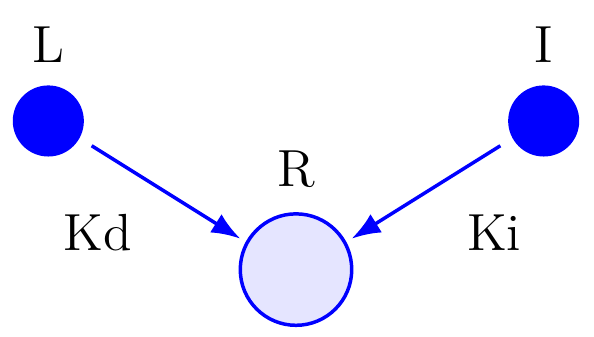
The Competitive Binding Equation estimates the inhibition constant Ki of a competing ligand from its measured IC50 value.
It is commonly known as the Cheng–Prusoff relationship and is widely used in receptor binding assays. Ki represents the affinity of the competitor for the receptor, corrected for the concentration and affinity of the reference ligand.
When to use it
Use this formula when analyzing competitive binding experiments where a test compound displaces a labeled or reference ligand from a receptor.
It is especially useful when converting experimental IC50 values into Ki values for comparison of ligand affinity.
Example
Given:
IC50 = 30 nM
L = 10 nM
Kd = 5 nM
Formula:
Ki = IC50 / (1 + L/Kd)
Substitution:
Ki = 30 / (1 + 10/5)
Ki = 30 / 3
Ki = 10 nM
Result:
The estimated inhibition constant of the competitor is 10 nM.
Applications
- Receptor binding assays
- Drug affinity comparison
- Competitive ligand displacement studies
- Pharmacology
- Drug discovery
- Molecular pharmacology
Note
This equation is an empirical correction used under competitive equilibrium binding assumptions. It assumes reversible competition between ligands at the same binding site and requires the concentration and Kd of the reference ligand. Other binding models may be needed for allosteric, irreversible, cooperative, or non-equilibrium systems.