
Variables
Description
What is this formula?
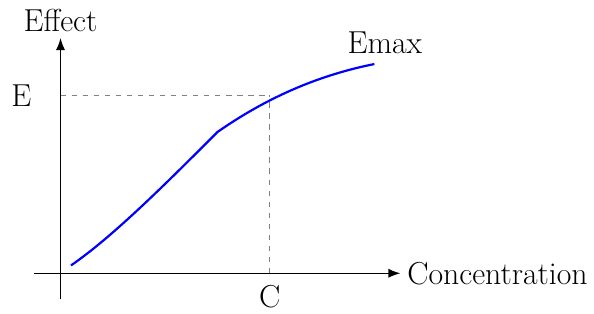
The Maximum Effect Concentration Model calculates the drug concentration required to produce a specified target effect according to the classical Emax model.
It is obtained by rearranging the Emax equation to solve directly for concentration instead of effect.
When to use it
Use this formula when estimating the concentration needed to reach a desired pharmacological effect, provided that the drug follows a simple saturable Emax relationship.
Example
Given:
E = 75
Emax = 100
EC50 = 5 mg/L
Formula:
C = (E × EC50)/(Emax − E)
Substitution:
C = (75 × 5)/(100 − 75)
C = 375/25
C = 15 mg/L
Result:
A concentration of 15 mg/L is required to produce the target effect.
Applications
- Pharmacodynamic modeling
- Target concentration estimation
- Clinical dose optimization
- PK/PD simulations
- Drug potency analysis
Note
This formula is an empirical rearrangement of the classical Emax model. It assumes a simple hyperbolic concentration–effect relationship with a Hill coefficient equal to 1. The target effect must be lower than Emax; as E approaches Emax, the required concentration increases sharply and becomes theoretically infinite.