
Variables
Description
What is this formula?
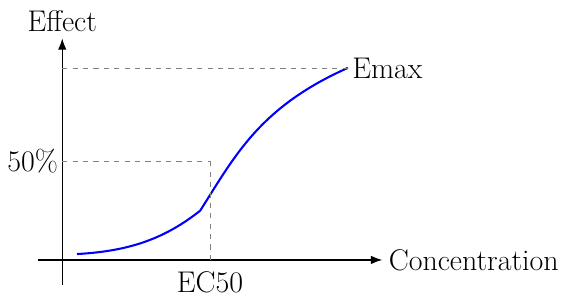
The Sigmoid Emax Model is one of the most widely used pharmacodynamic models for describing the relationship between drug concentration and observed effect.
It extends the basic Emax model by introducing the sigmoidicity coefficient (γ), allowing the curve to become steeper or shallower than the standard hyperbolic response.
The model also incorporates a baseline effect (E0), making it useful for biological systems where a measurable response exists before drug administration.
When to use it
Use this model when:
- A baseline response exists before treatment
- Drug response exhibits a sigmoidal shape
- Concentration–effect data require flexible curve fitting
- Performing PK/PD modeling
- Comparing potency and efficacy between drugs
Example
Given:
E0 = 10
Emax = 90
EC50 = 4 mg/L
γ = 2
C = 6 mg/L
Formula:
E = E0 + (Emax × C²)/(EC50² + C²)
Substitution:
E = 10 + (90 × 36)/(16 + 36)
E = 10 + 3240/52
E = 72.31
Result:
The predicted effect is approximately 72.3 units.
Applications
- Population pharmacodynamics
- Clinical dose optimization
- Drug development
- PK/PD simulations
- Therapeutic response modeling
- Receptor-mediated response analysis
Note
The Sigmoid Emax Model is an empirical pharmacodynamic model. The parameter γ controls the steepness of the curve and may reflect cooperativity, amplification mechanisms, or simply the shape of the observed data. Several equivalent parameterizations exist in the literature, but this form is among the most commonly used in PK/PD modeling.