
Variables
Description
What is this formula?
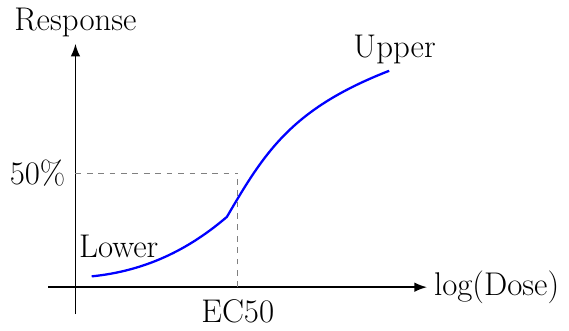
The Log-Logistic Dose Response Model is a flexible pharmacodynamic model widely used to describe sigmoidal dose–response relationships when the dose or concentration is analyzed on a logarithmic scale.
Unlike the basic Hill model, it explicitly includes both lower and upper response limits, making it particularly useful for experimental data fitting.
When to use it
Use this model when:
- Analyzing concentration–response data on a logarithmic scale
- Fitting experimental pharmacological data
- Estimating EC50 values
- Comparing drug potency and efficacy
- Modeling biological responses with upper and lower asymptotes
Example
Given:
Emin = 0
Emax = 100
EC50 = 10 mg/L
b = 1.5
C = 20 mg/L
Formula:
E = Emin + (Emax − Emin)/(1 + (EC50/C)^b)
Substitution:
E = 0 + 100/(1 + (10/20)^1.5)
E = 100/(1 + 0.3536)
E = 73.9%
Result:
The predicted response is approximately 73.9% of the maximal response.
Applications
- Pharmacodynamics
- Toxicology
- Bioassay analysis
- Dose optimization
- Drug potency estimation
- Experimental curve fitting
Note
The Log-Logistic model is an empirical curve-fitting model. Different parameterizations are used in pharmacology, toxicology, agronomy, and biostatistics. Some versions use logarithmic dose directly, while others use concentration. Parameter definitions may therefore vary slightly between publications.