
Variables
Description
What is this formula?
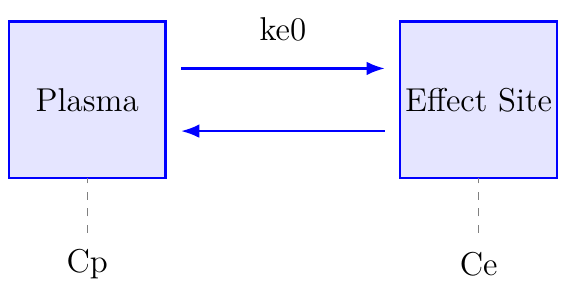
The Effect Site Response Model relates drug effect to the concentration at the biophase or effect site rather than to the plasma concentration.
Many drugs exhibit a delay between plasma concentration and observed response. Using effect-site concentration helps account for this hysteresis and provides a more accurate pharmacodynamic description.
The pharmacological effect is usually modeled using a sigmoidal Emax relationship driven by effect-site concentration.
When to use it
Use this model when:
- Drug effect lags behind plasma concentration
- PK/PD modeling requires an effect compartment
- Studying anesthetics and sedatives
- Modeling delayed pharmacological responses
- Quantifying hysteresis between concentration and effect
Example
Given:
Emax = 100
Ce = 4 mg/L
EC50 = 2 mg/L
γ = 2
Formula:
E = (Emax × Ce²)/(EC50² + Ce²)
Substitution:
E = (100 × 16)/(4 + 16)
E = 1600/20
E = 80
Result:
The predicted effect is 80% of the maximum possible response.
Applications
- PK/PD modeling
- Anesthesia pharmacology
- Sedative drug analysis
- Analgesic response modeling
- Drug development
- Clinical pharmacometrics
Note
This equation describes the concentration–effect relationship once the effect-site concentration is known. Determining the effect-site concentration itself typically requires an additional pharmacokinetic model involving an effect-compartment rate constant (ke0). Alternative effect-site models exist depending on the drug and therapeutic area.