
Variables
Description
What is this formula?
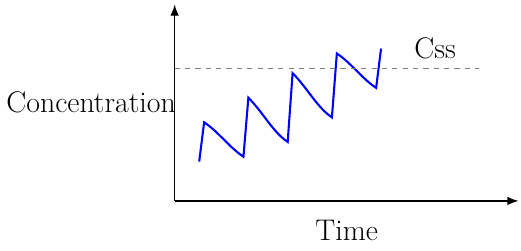
The Steady-State Concentration after Repeated Dosing estimates the concentration achieved when the rate of drug administration equals the rate of drug elimination. At this point, average drug levels remain stable from one dosing interval to the next.
When to use it
Use this formula when designing repeated-dose regimens, estimating long-term drug exposure, and evaluating the effects of dosing interval and elimination rate on drug accumulation.
Example
Data:
D = 500 mg
Vd = 40 L
k = 0.1 1/h
tau = 12 h
Formula:
Css = D / (Vd × (1 − e^(-k×tau)))
Substitution:
Css = 500 / (40 × (1 − e^(-0.1×12)))
Result:
Css = 17.97 mg/L
Applications
- Repeated-dose regimen design
- Therapeutic drug monitoring
- Pharmacokinetic simulations
- Clinical pharmacology
- Drug accumulation studies
Note
This formula is derived from a one-compartment pharmacokinetic model with first-order elimination and instantaneous distribution. It assumes constant pharmacokinetic parameters and complete adherence to the prescribed dosing schedule. Real drug concentrations may differ due to absorption kinetics, multicompartment distribution, nonlinear elimination, and patient-specific variability.