
Variables
Description
What is this formula?
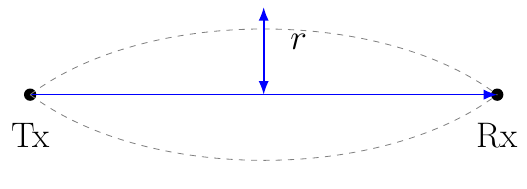
The Fresnel Zone Radius calculates the radius of the first Fresnel zone at a specific point along a radio path. It is used to determine whether obstacles may cause diffraction losses and degrade communication performance.
When to use it
Use this formula when planning microwave links, wireless backhaul systems, point-to-point radio links, and any line-of-sight communication system where terrain clearance is important.
Example
A radio link contains a hill located 5 km from the transmitter and 5 km from the receiver. The operating wavelength is 0.125 m.
Formula:
r = √((λ*d1*d2)/(d1+d2))
Substitution:
r = √((0.125*5000*5000)/(5000+5000))
Result:
r = 17.68 m
The first Fresnel zone radius at the obstacle location is approximately 17.7 m.
Applications
Microwave communications, cellular backhaul networks, wireless internet service providers, satellite ground stations, radio path surveys, and telecommunications engineering.
Note
This formula calculates the radius of the first Fresnel zone, which is the most important for radio link design. A common engineering guideline is to keep at least 60% of the first Fresnel zone free of obstacles to minimize diffraction losses. Additional Fresnel zones exist but are usually less critical in practical link design.