
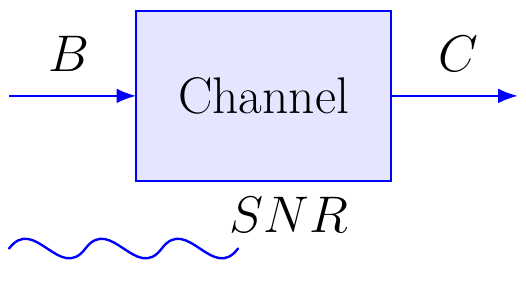
Variables
Description
What is this formula?
The Shannon Channel Capacity formula determines the theoretical maximum data rate that can be transmitted through a communication channel with a specified bandwidth and signal-to-noise ratio while maintaining arbitrarily low error probability.
When to use it
Use this formula when evaluating communication system performance, estimating maximum achievable throughput, comparing technologies, designing wireless networks, or studying information theory.
Example
A communication channel has a bandwidth of 20 MHz and an SNR of 100.
Formula:
C = B*log2(1+SNR)
Substitution:
C = 20000000*log2(101)
Result:
C = 133164123 bit/s
C = 133.16 Mbps
Applications
Wireless communications, fiber-optic systems, satellite communications, cellular networks, Wi-Fi systems, modem design, coding theory, and information theory.
Note
The Shannon-Hartley theorem establishes a theoretical upper limit on channel capacity under ideal assumptions of additive white Gaussian noise (AWGN). Real communication systems always operate below the Shannon limit due to practical constraints such as modulation efficiency, coding limitations, implementation losses, interference, fading, and hardware imperfections. Nevertheless, this formula remains one of the most important benchmarks in telecommunications engineering.