
Variables
Description
What is this formula?
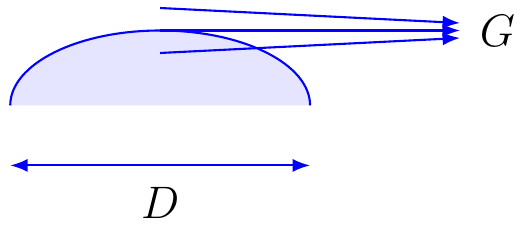
This formula estimates the gain of a parabolic dish antenna from its physical diameter, operating wavelength, and efficiency. It is one of the most important equations in satellite and microwave communication engineering.
When to use it
Use this formula when designing satellite earth stations, microwave links, radio telescopes, deep-space communication systems, or evaluating antenna performance.
Example
A parabolic antenna has a diameter of 3 m, an efficiency of 0.65, and operates at a wavelength of 0.03 m.
Formula:
G = η(πD/λ)²
Substitution:
G = 0.65×(π×3/0.03)²
Result:
G = 64206
G = 48.08 dBi
Applications
Satellite communications, VSAT systems, microwave links, radio astronomy, radar systems, deep-space communications, and antenna engineering.
Note
This equation is an approximation for aperture-type antennas such as parabolic reflectors. Actual gain depends on illumination efficiency, surface accuracy, feed design, blockage losses, polarization effects, and manufacturing tolerances. Antenna efficiency typically ranges from 0.5 to 0.75 for many practical dish antennas.