
Variables
Description
What is this formula?
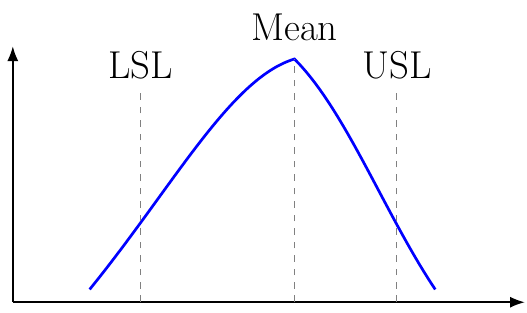
The Process Performance Index (Ppk) measures the actual long-term ability of a process to produce within specification limits.
Unlike Pp, Ppk also considers how well the process is centered relative to the specification limits.
When to use it
Use this formula when:
- Evaluating long-term process performance.
- Assessing customer specification compliance.
- Monitoring manufacturing quality.
- Supporting Six Sigma programs.
- Comparing actual process capability.
Example
A process has:
USL = 50.5 mm
LSL = 49.5 mm
μ = 49.9 mm
s = 0.15 mm
Formula:
Ppu = (USL − μ)/(3s)
Ppl = (μ − LSL)/(3s)
Substitution:
Ppu = (50.5 − 49.9)/(3×0.15)
Ppu = 1.33
Ppl = (49.9 − 49.5)/(3×0.15)
Ppl = 0.89
Result:
Ppk = min(1.33, 0.89)
Ppk = 0.89
Applications
- Statistical Process Control
- Six Sigma
- Manufacturing quality
- Process auditing
- Industrial quality engineering
Note
Ppk is the long-term counterpart of Cpk. While Cpk is based on short-term process variation, Ppk uses overall process variation and therefore better reflects the actual performance experienced by customers over time.