
Variables
Description
What is this formula?
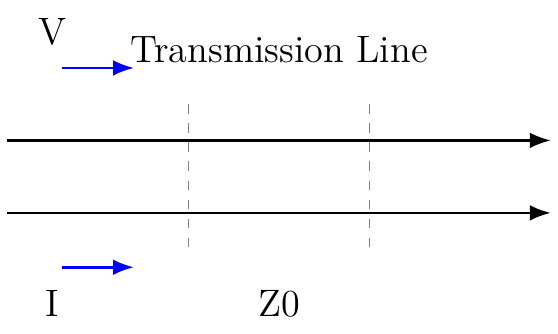
Characteristic impedance is the natural impedance of a transmission line. It represents the voltage-to-current ratio of a travelling wave moving along the line when no reflections are present.
When to use it
Use this formula when analyzing transmission lines, RF systems, coaxial cables, communication networks, impedance matching circuits, and high-frequency power systems.
Example
A transmission line has:
Inductance per unit length = 250 nH/m
Capacitance per unit length = 100 pF/m
Convert units:
L = 250 × 10^-9 H/m
C = 100 × 10^-12 F/m
Formula:
Z0 = √(L/C)
Substitution:
Z0 = √((250 × 10^-9)/(100 × 10^-12))
Result:
Z0 = 50 Ω
Applications
RF transmission lines
Coaxial cable design
Telecommunication systems
Microwave engineering
Impedance matching
Signal integrity analysis
Note
This equation corresponds to an ideal low-loss transmission line. Real transmission lines also exhibit resistance and dielectric losses, causing the exact characteristic impedance to be represented by a more general complex expression involving R, L, G, and C parameters.