
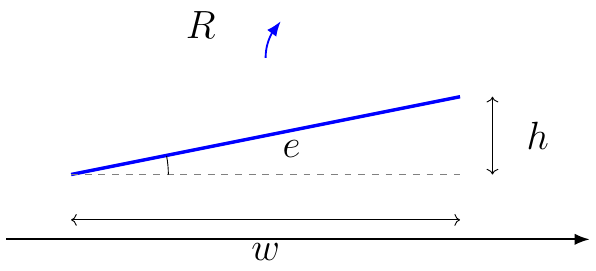
Variables
Description
What is this formula?
The Superelevation Rate equation estimates the roadway cross slope required to counteract the centrifugal effects experienced by vehicles traveling through a horizontal curve.
Superelevation improves vehicle stability, safety, and comfort by reducing the lateral friction demand between tires and pavement.
When to use it
Use this formula when designing:
- Highway horizontal curves
- Urban road curves
- Rural roads
- Expressways
- Mountain roads
The equation represents the ideal balance condition where the entire lateral acceleration is resisted by roadway banking.
Example
A highway curve has:
v = 25 m/s
R = 300 m
g = 9.81 m/s²
Formula:
e = v²/(gR)
Substitution:
e = 25²/(9.81×300)
e = 625/2943
e = 0.212
Result:
e = 0.212
e = 21.2%
Applications
- Highway geometric design
- Horizontal alignment design
- Transportation engineering
- Road safety analysis
- Curve design
- Highway rehabilitation
Note
This equation represents the theoretical equilibrium superelevation. Actual highway design standards typically combine superelevation and side-friction factors, resulting in lower design superelevation values. Agencies such as AASHTO usually impose maximum superelevation limits ranging from approximately 6% to 12% depending on climate and roadway type.