
Variables
Description
What is this formula?
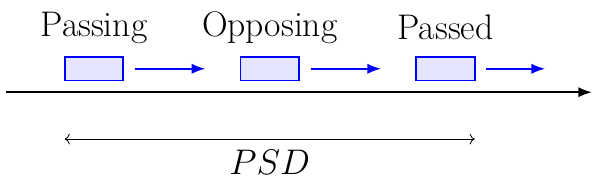
The Passing Sight Distance formula estimates the minimum roadway distance required for a vehicle to safely pass a slower vehicle on a two-lane road while avoiding conflict with an opposing vehicle.
It combines the distance needed for the initial maneuver, the passing movement, a safety clearance, and the distance traveled by the opposing vehicle.
When to use it
Use this formula when evaluating:
- Two-lane rural highways
- No-passing zones
- Road safety studies
- Horizontal alignment design
- Sight distance requirements
Example
A highway passing maneuver has:
d1 = 45 m
d2 = 180 m
d3 = 30 m
d4 = 150 m
Formula:
PSD = d1 + d2 + d3 + d4
Substitution:
PSD = 45 + 180 + 30 + 150
PSD = 405 m
Result:
PSD = 405 m
Applications
- Highway geometric design
- No-passing zone analysis
- Rural road safety
- Horizontal curve evaluation
- Transportation engineering studies
Note
Passing sight distance is a design-based engineering estimate. Actual highway manuals may use speed-dependent tables, assumed acceleration behavior, opposing vehicle speed, driver perception-reaction time, and specific safety margins. This formula represents the component-sum structure commonly used to explain the concept.