
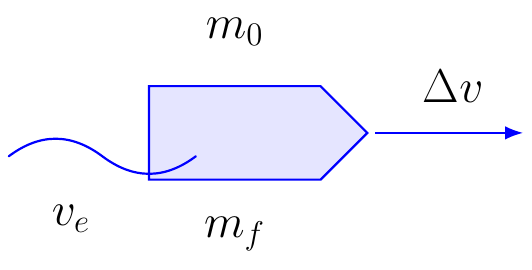
Variables
Description
What is this formula?
The Tsiolkovsky Rocket Equation calculates the theoretical change in velocity (delta-v) that a rocket can achieve based on its mass ratio and effective exhaust velocity.
It is one of the most fundamental equations in astronautics and rocket engineering.
When to use it
Use this equation when estimating spacecraft performance, rocket staging requirements, mission feasibility, or propellant requirements.
It is widely used in launch vehicle design, orbital mission planning, and deep-space mission analysis.
Example
A spacecraft has:
Initial mass = 50000 kg
Final mass = 10000 kg
Effective exhaust velocity = 3000 m/s
Formula:
Δv = ve × ln(m0/mf)
Substitution:
Δv = 3000 × ln(50000/10000)
Δv = 3000 × ln(5)
Δv = 4828 m/s
Result:
Delta-v = 4.83 km/s
Applications
Rocket design
Space mission planning
Launch vehicle analysis
Propellant budgeting
Spacecraft performance estimation
Astronautics
Note
The Tsiolkovsky Rocket Equation assumes ideal rocket operation in vacuum and neglects gravity losses, aerodynamic drag, steering losses, and engine performance variations. Real missions generally require more propellant than predicted by the ideal equation. Multi-stage rockets apply the equation separately to each stage.