
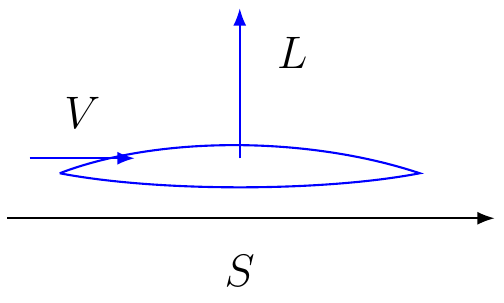
Variables
Description
What is this formula?
The Lift Equation calculates the aerodynamic lift generated by a wing, airfoil, rotor blade, or other lifting surface moving through a fluid.
It is one of the most important equations in aerodynamics and aircraft performance analysis.
When to use it
Use this equation when estimating lift generated by an aircraft wing, UAV, helicopter rotor, wind tunnel model, or aerodynamic surface.
It is widely used in aircraft design, flight performance calculations, aerospace engineering education, and CFD validation.
Example
An aircraft wing has:
Air density = 1.225 kg/m³
Velocity = 70 m/s
Wing area = 16 m²
Lift coefficient = 0.8
Formula:
L = 0.5 × ρ × V² × S × CL
Substitution:
L = 0.5 × 1.225 × 70² × 16 × 0.8
L = 38416 N
Result:
Lift force = 38.4 kN
Applications
Aircraft wing design
UAV performance analysis
Wind tunnel testing
Flight mechanics
Aerodynamic simulations
Aerospace engineering
Note
The lift coefficient is an empirical aerodynamic parameter that depends on airfoil shape, angle of attack, Reynolds number, Mach number, and flow conditions. The equation provides an engineering model of aerodynamic lift and is valid within the operating conditions used to determine the lift coefficient.