
Variables
Description
What is this formula?
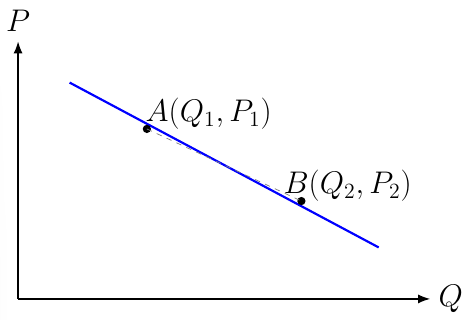
Arc Elasticity measures elasticity between two points on a demand or supply curve using average values instead of initial values.
This method avoids the asymmetry that occurs when elasticity is calculated using only the starting point as the reference.
When to use it
Use this formula when price or quantity changes are relatively large and a more balanced elasticity estimate is desired.
It is commonly used in economic studies, market analysis, and textbook applications.
Example
Initial price:
P1 = 10 USD
Final price:
P2 = 12 USD
Initial quantity:
Q1 = 100 units
Final quantity:
Q2 = 80 units
Formula:
Ea = ((Q2−Q1)/((Q1+Q2)/2))/((P2−P1)/((P1+P2)/2))
Substitution:
Ea = ((80−100)/90)/((12−10)/11)
Ea = -0.2222/0.1818
Ea = -1.22
Result:
The arc elasticity is approximately -1.22, indicating elastic demand over the interval.
Applications
- Demand analysis
- Supply analysis
- Market research
- Economic education
- Price policy evaluation
Note
Arc elasticity is often preferred over point elasticity when analyzing discrete changes because it produces the same result regardless of the direction of the change. This symmetry makes comparisons more consistent.