
Variables
Description
What is this formula?
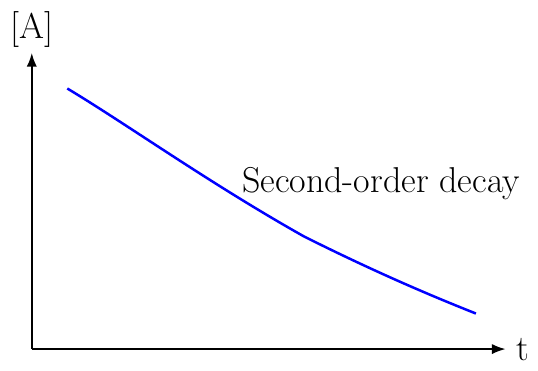
The second-order rate law describes the concentration change of a reactant when the reaction rate is proportional to the square of its concentration or to the product of two reactant concentrations.
When to use it
Use this formula for reactions that exhibit second-order kinetics and where the integrated rate law applies to a single reactant concentration profile.
Example
Given:
A0 = 0.50 mol/L
k = 0.20 L·mol^-1·s^-1
t = 10 s
Formula:
1/A = 1/A0 + kt
Substitution:
1/A = 1/0.50 + (0.20×10)
1/A = 2 + 2
1/A = 4
Result:
A = 0.25 mol/L
Applications
Chemical kinetics
Reaction mechanism studies
Organic chemistry
Polymerization kinetics
Reaction engineering
Note
This integrated form assumes second-order kinetics with respect to a single reactant concentration. More complex second-order systems involving different initial concentrations of multiple reactants require alternative integrated expressions. Experimental verification is usually performed by checking whether 1/[A] varies linearly with time.