
Variables
Description
What is this formula?
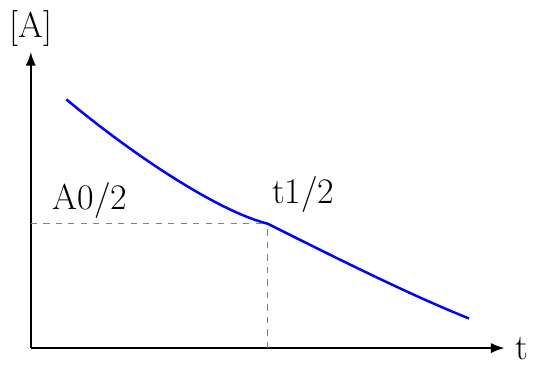
The half-life of a reaction is the time required for the concentration of a reactant to decrease to one-half of its initial value.
For first-order reactions, the half-life is constant and depends only on the rate constant.
When to use it
Use this formula when analyzing first-order reactions, radioactive decay, pharmaceutical degradation, and many natural exponential decay processes.
Example
Given:
k = 0.035 s^-1
Formula:
t½ = ln(2)/k
Substitution:
t½ = 0.693/0.035
Result:
t½ = 19.8 s
After 19.8 seconds, the reactant concentration will have decreased to one-half of its original value.
Applications
Chemical kinetics
Radioactive decay
Pharmaceutical stability
Environmental chemistry
Reaction engineering
Note
This formula applies specifically to first-order kinetics. Unlike first-order reactions, the half-life of zero-order and second-order reactions depends on the initial concentration and therefore changes as the reaction proceeds.
Because of its simplicity and broad applicability, the first-order half-life is the most commonly reported half-life in chemistry, pharmacology, and nuclear science.