
Variables
Description
What is this formula?
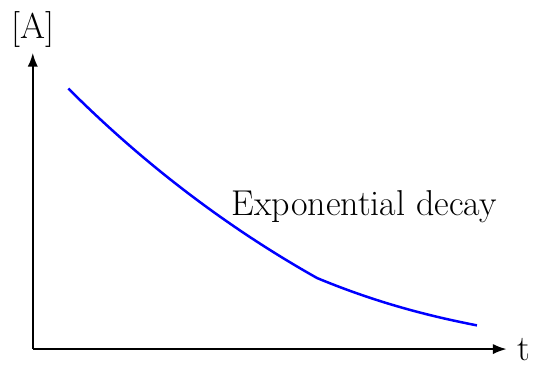
The first-order rate law describes the exponential decrease of a reactant concentration when the reaction rate is proportional to the concentration of one reactant.
When to use it
Use this formula for first-order reactions, radioactive decay, unimolecular decomposition, solvolysis reactions, and many degradation processes.
Example
Given:
A0 = 0.80 mol/L
k = 0.030 s^-1
t = 25 s
Formula:
A = A0 e^(-kt)
Substitution:
A = 0.80 × e^(-0.030×25)
Result:
A = 0.378 mol/L
Applications
Chemical kinetics
Decomposition reactions
Organic reaction mechanisms
Pharmaceutical degradation
Environmental chemistry
Note
This integrated rate law applies when the reaction follows first-order kinetics under the conditions studied. Real systems may deviate from first-order behavior due to competing reactions, changes in mechanism, catalyst deactivation, transport limitations, or non-ideal reaction conditions.