
Variables
Description
What is this formula?
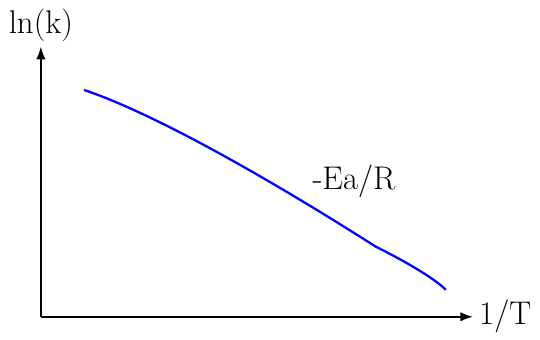
The Arrhenius equation relates the rate constant of a chemical reaction to temperature and activation energy.
It is one of the most important equations in chemical kinetics because it explains why reaction rates generally increase as temperature rises.
When to use it
Use this equation when estimating reaction rates at different temperatures, determining activation energies, or analyzing temperature effects on chemical processes.
Example
Given:
A = 1.0×10^12 s^-1
Ea = 75000 J/mol
R = 8.314 J·mol^-1·K^-1
T = 298 K
Formula:
k = A·e^(-Ea/(RT))
Substitution:
k = 1.0×10^12 × e^(-75000/(8.314×298))
Result:
k ≈ 7.2×10^-2 s^-1
Applications
Chemical kinetics
Reaction engineering
Catalysis
Polymer chemistry
Combustion science
Pharmaceutical stability
Note
The Arrhenius equation is an empirical model that successfully describes the temperature dependence of many chemical reactions. The pre-exponential factor A and activation energy Ea are typically determined experimentally.
Although highly successful, some reactions exhibit deviations from Arrhenius behavior due to complex mechanisms, diffusion limitations, quantum tunneling effects, phase changes, or catalyst-related phenomena.