
Variables
Description
What is this formula?
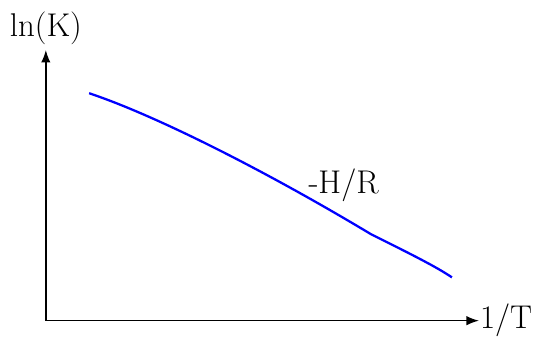
The Van't Hoff equation describes how the equilibrium constant of a chemical reaction changes with temperature.
When to use it
Use this equation when estimating equilibrium constants at different temperatures, analyzing temperature effects on equilibrium, or studying thermodynamic properties of reactions.
Example
Given:
K1 = 10
ΔH = 50000 J/mol
T1 = 298 K
T2 = 350 K
R = 8.314 J·mol⁻¹·K⁻¹
Formula:
ln(K2/K1) = -(ΔH/R)(1/T2 - 1/T1)
Substitution:
ln(K2/10) = -(50000/8.314)(1/350 - 1/298)
Result:
K2 ≈ 0.51
The equilibrium constant decreases as temperature increases, indicating behavior consistent with an exothermic reaction.
Applications
Chemical thermodynamics
Equilibrium analysis
Reaction engineering
Industrial chemistry
Process optimization
Note
The Van't Hoff equation assumes that the reaction enthalpy remains approximately constant over the temperature range considered. For large temperature intervals, heat capacity effects may become important and more advanced thermodynamic models may be required.
The sign of ΔH determines how equilibrium responds to temperature changes. Exothermic reactions (ΔH < 0) generally exhibit decreasing equilibrium constants as temperature increases, while endothermic reactions (ΔH > 0) typically show the opposite behavior.