
Variables
Description
What is this formula?
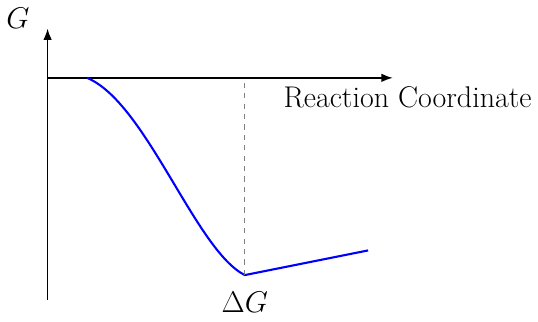
The binding free energy quantifies the thermodynamic favorability of a binding interaction between a ligand and its target.
More negative free energy values correspond to stronger binding affinity and lower dissociation constants.
This relationship links molecular binding thermodynamics with experimentally measured equilibrium constants.
When to use it
Use this formula when studying protein-ligand interactions, receptor binding, molecular docking, medicinal chemistry, biophysics, and thermodynamic analysis.
Example
A ligand has:
Kd = 1×10⁻⁹ mol/L
T = 298 K
R = 8.314 J·mol⁻¹·K⁻¹
Formula:
ΔG = RT ln(Kd)
Substitution:
ΔG = 8.314 × 298 × ln(1×10⁻⁹)
ΔG = -51.4 kJ/mol
Result:
Binding free energy ≈ -51.4 kJ/mol
The negative value indicates spontaneous and favorable binding.
Applications
- Protein-ligand interactions
- Drug discovery
- Molecular docking
- Structural biology
- Biophysics
- Medicinal chemistry
- Thermodynamic analysis
Note
This equation assumes equilibrium conditions and standard-state thermodynamics. In many biochemical references the relationship may be written as:
ΔG° = RT ln(Kd)
or equivalently:
ΔG° = -RT ln(Ka)
where Ka is the association constant. Both expressions describe the same thermodynamic relationship using reciprocal equilibrium constants.