
Variables
Description
What is this formula?
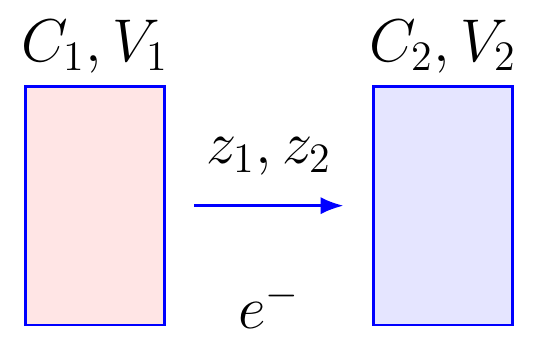
This equation expresses the equivalence condition in redox titrations. At the equivalence point, the total number of electrons lost by the reducing agent equals the total number of electrons gained by the oxidizing agent.
When to use it
Use this formula in oxidation-reduction titrations involving permanganate, dichromate, iodine, cerium, iron, or other redox systems.
Example
A 25.0 mL iron(II) solution is titrated with 0.0200 mol/L potassium dichromate.
Reaction:
Cr2O7²⁻ + 14H⁺ + 6Fe²⁺ → 2Cr³⁺ + 6Fe³⁺ + 7H2O
Data:
V1 = 25.0 mL
C2 = 0.0200 mol/L
V2 = 15.0 mL
z1 = 1
z2 = 6
Formula:
z1C1V1 = z2C2V2
Substitution:
1 × C1 × 25.0 = 6 × 0.0200 × 15.0
Result:
C1 = 0.0720 mol/L
The Fe²⁺ concentration is 0.0720 mol/L.
Applications
- Permanganate titrations
- Dichromate titrations
- Iodometric analysis
- Environmental chemistry
- Metallurgical analysis
- Pharmaceutical quality control
Note
The electron transfer numbers must be obtained from the balanced redox reaction. Incorrect oxidation numbers or electron counts will produce incorrect results even when concentration and volume measurements are accurate.