
Variables
Description
What is this formula?
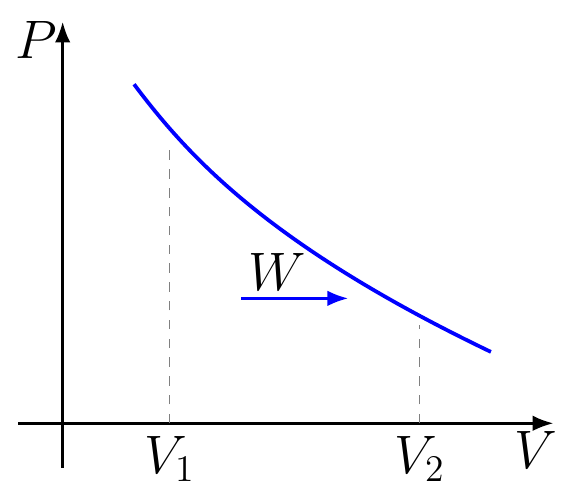
This formula calculates the work performed by an ideal gas during an isothermal process, where the temperature remains constant. Under these conditions, the internal energy of the ideal gas does not change and the heat transferred equals the work performed.
When to use it
Use this equation when analyzing ideal gases undergoing expansion or compression at constant temperature. It is commonly used in thermodynamics, heat engines, and gas process calculations.
Example
Given:
n = 1 mol
T = 300 K
V1 = 0.010 m³
V2 = 0.020 m³
R = 8.314 J/mol·K
Formula:
W = nRT ln(V2/V1)
Substitution:
W = 1 × 8.314 × 300 × ln(0.020/0.010)
Result:
W = 1728 J
Applications
Isothermal gas expansion, piston-cylinder systems, thermodynamic cycle analysis, heat engines, refrigeration studies, and engineering calculations involving ideal gases.