
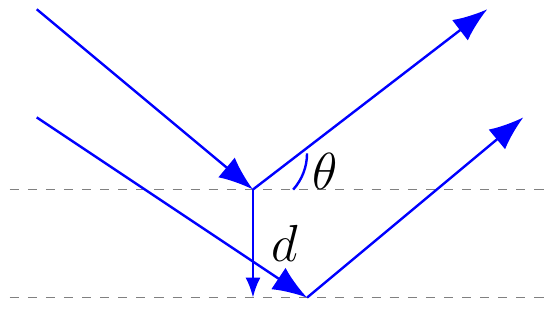
\[n\lambda=2d\sin(\theta)\]
Variables
lambda[λ]wavelength (m)
dinterplanar spacing (m)
theta[θ]Bragg diffraction angle (rad)
ndiffraction order
Description
What is this formula?
Bragg's law calculates the diffraction angle produced when waves such as X-rays are reflected by parallel atomic planes inside a crystal. It relates wavelength, interplanar spacing, and diffraction angle.
When to use it
This formula is used in crystallography, X-ray diffraction, materials science, and solid state physics to analyze crystal structures and determine atomic spacing.
Example
An X-ray beam with wavelength:
λ = 1.54×10^-10 m
is diffracted by crystal planes separated by:
d = 2.00×10^-10 m
for first-order diffraction:
n = 1
Using:
nλ = 2d sin(θ)
Substitution:
1×1.54×10^-10 = 2×2.00×10^-10×sin(θ)
Result:
θ ≈ 0.395 rad
Applications
- X-ray crystallography
- Crystal structure analysis
- Materials science
- Semiconductor characterization
- Solid state physics
- Diffraction experiments