
Variables
Description
What is this formula?
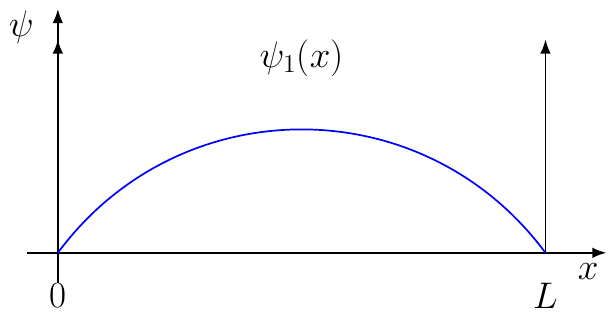
This formula describes the normalized wavefunction of a particle confined within a one-dimensional infinite potential well, commonly known as the particle-in-a-box model. The wavefunction represents the probability amplitude of finding the particle at a specific position inside the well.
The square of the wavefunction gives the probability density, allowing the likelihood of finding the particle at different positions to be determined. Unlike classical particles, which may occupy any position with equal probability, quantum particles exhibit standing-wave patterns with nodes and antinodes that depend on the quantum number.
When to use it
Use this formula when studying quantum confinement, stationary states, probability distributions, infinite potential wells, and introductory quantum mechanics. It is widely used in nanotechnology, semiconductor physics, and quantum well analysis.
Example
Given:
Well length = 1 × 10^-9 m
Position = 0.5 × 10^-9 m
Quantum number = 1
Formula:
ψn(x) = √(2/L) × sin(nπx/L)
Substitution:
ψ1(x) = √(2/(1 × 10^-9)) × sin((1 × π × 0.5 × 10^-9)/(1 × 10^-9))
Result:
ψ1(x) ≈ 4.47 × 10^4 m^-1/2
This value represents the probability amplitude of finding the particle at the specified position for the ground-state wavefunction.
Applications
Quantum confinement analysis
Probability density calculations
Infinite potential wells
Quantum wells
Semiconductor nanostructures
Nanotechnology
Physics education
Note
The wavefunction is normalized so that the total probability of finding the particle somewhere inside the well is equal to one. The quantum number determines the number of standing-wave nodes inside the well, with higher-energy states exhibiting more oscillations. The particle cannot exist outside the infinite potential well, where the wavefunction is identically zero.