
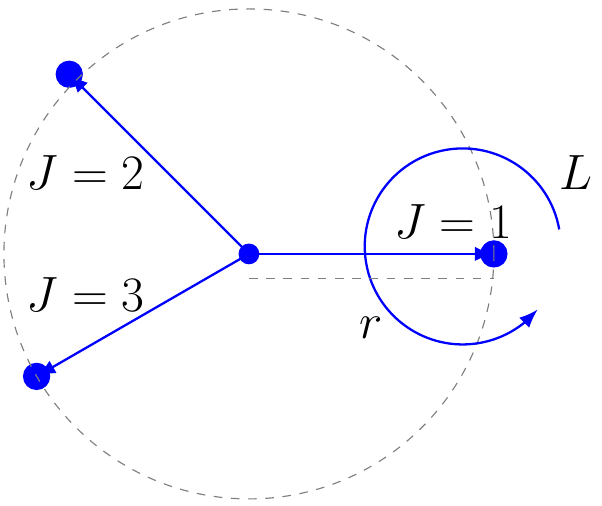
Variables
Description
What is this formula?
This formula calculates the quantized rotational energy levels of a rigid rotor in quantum mechanics. The rigid rotor model assumes that the distance between the atoms of a rotating molecule remains constant, making it one of the simplest and most important models for describing molecular rotation.
The rotational energy depends on the molecule's moment of inertia and the rotational quantum number. Because only specific rotational states are allowed, molecules absorb or emit electromagnetic radiation at discrete rotational frequencies.
When to use it
Use this formula when studying rotational motion in diatomic or linear molecules, molecular spectroscopy, microwave spectroscopy, quantum chemistry, and molecular physics. It is especially useful for analyzing rotational transitions and determining molecular structure.
Example
Given:
Moment of inertia = 2 × 10^-46 kg·m²
Rotational quantum number = 2
Reduced Planck constant = 1.055 × 10^-34 J·s
Formula:
EJ = J(J + 1) × ℏ² / (2 × I)
Substitution:
E2 = 2 × (2 + 1) × (1.055 × 10^-34)² / (2 × 2 × 10^-46)
Result:
E2 ≈ 1.67 × 10^-22 J
This value represents the rotational energy of the molecule for the quantum state J = 2.
Applications
Rotational spectroscopy
Microwave spectroscopy
Molecular physics
Quantum chemistry
Molecular structure analysis
Diatomic molecule studies
Physics education
Note
The rotational quantum number J can only take non-negative integer values (0, 1, 2, ...). The spacing between successive rotational energy levels increases as J increases. The rigid rotor approximation provides an excellent description of rotational spectra for many diatomic molecules, although more advanced models include centrifugal distortion for higher rotational states.