
Variables
Description
What is this formula?
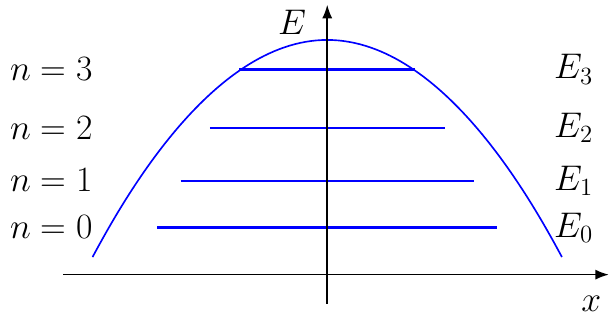
This formula calculates the quantized energy levels of a quantum harmonic oscillator. Unlike a classical harmonic oscillator, which can possess any value of energy, the quantum harmonic oscillator is restricted to discrete energy levels.
One of its most important features is the existence of zero-point energy, meaning the oscillator always retains a minimum amount of energy even at absolute zero. This model is one of the fundamental exact solutions of quantum mechanics and accurately describes many microscopic vibrating systems.
When to use it
Use this formula when analyzing systems that behave approximately as harmonic oscillators near their equilibrium position. It is widely used in molecular vibration analysis, solid-state physics, quantum optics, phonon theory, spectroscopy, and quantum field theory.
Example
Given:
Angular frequency = 2 × 10^15 rad/s
Quantum number = 1
Reduced Planck constant = 1.055 × 10^-34 J·s
Formula:
Eₙ = (n + 0.5) × ℏ × ω
Substitution:
E₁ = (1 + 0.5) × (1.055 × 10^-34) × (2 × 10^15)
Result:
E₁ ≈ 3.17 × 10^-19 J
This value corresponds to the energy of the first excited quantum state of the oscillator.
Applications
Quantum mechanics
Molecular vibration analysis
Quantum optics
Solid-state physics
Phonon models
Spectroscopy
Quantum field theory
Note
The energy levels are equally spaced, with the separation between adjacent levels equal to ℏω. Even in its lowest-energy state (n = 0), the oscillator possesses a finite zero-point energy equal to 0.5 × ℏ × ω. This property has important consequences in atomic physics, molecular spectroscopy, condensed matter physics, and quantum field theory.