
Variables
Description
What is this formula?
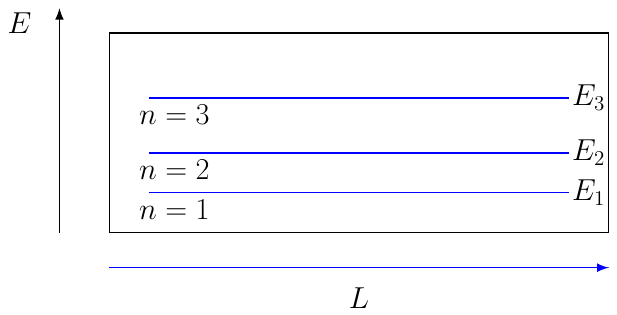
This formula calculates the allowed quantized energy levels of a particle confined within a one-dimensional infinite potential well, commonly known as the particle-in-a-box model.
Unlike classical mechanics, where a confined particle may possess any energy, quantum mechanics predicts that only discrete energy values are permitted. The energy depends on the particle's mass, the length of the box, and the quantum number that identifies each allowed state. This model is one of the fundamental exact solutions of quantum mechanics and provides the basis for understanding quantum confinement.
When to use it
Use this formula when analyzing quantum systems in which a particle is confined between perfectly rigid boundaries. It is widely used in quantum mechanics, semiconductor physics, nanotechnology, quantum wells, quantum dots, and nanoscale device analysis.
Example
Given:
Particle mass = 9.11 × 10^-31 kg
Box length = 1 × 10^-9 m
Quantum number = 1
Formula:
Eₙ = (n²·h²)/(8·m·L²)
Substitution:
E₁ = (1² × (6.626 × 10^-34)²) / (8 × 9.11 × 10^-31 × (1 × 10^-9)²)
Result:
E₁ ≈ 6.02 × 10^-20 J
This value represents the minimum (ground-state) energy that the particle can possess inside the box.
Applications
Quantum mechanics
Quantum wells
Quantum dots
Semiconductor devices
Nanotechnology
Atomic confinement models
Physics education
Note
The energy levels increase with the square of the quantum number, meaning higher quantum states become progressively farther apart in energy. Smaller confinement dimensions also produce significantly higher energy levels, making this model especially important for understanding the behavior of electrons in nanoscale materials and semiconductor structures.