
Variables
Description
What is this formula?
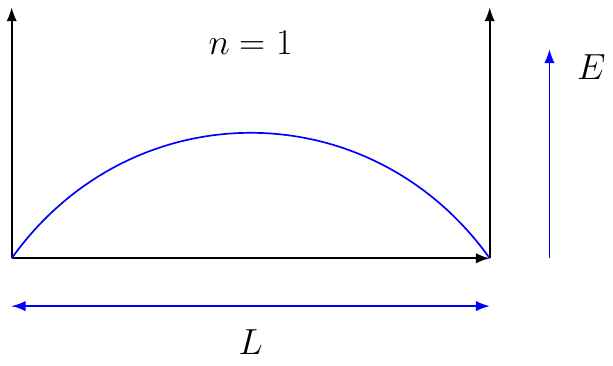
This formula calculates the ground-state energy of a particle confined within a one-dimensional infinite potential well. It represents the lowest possible energy that the particle can possess according to quantum mechanics.
Unlike a classical particle, which could theoretically remain at rest with zero energy, a confined quantum particle always retains a finite amount of energy due to the uncertainty principle. This minimum energy is known as the ground-state energy or zero-point confinement energy.
When to use it
Use this formula when studying quantum confinement, infinite potential wells, semiconductor nanostructures, quantum wells, and the lowest allowed energy state of a confined particle. It is widely used in introductory quantum mechanics and nanotechnology.
Example
Given:
Particle mass = 9.11 × 10^-31 kg
Well length = 2 × 10^-9 m
Planck constant = 6.626 × 10^-34 J·s
Formula:
E1 = h² / (8 × m × L²)
Substitution:
E1 = (6.626 × 10^-34)² / (8 × 9.11 × 10^-31 × (2 × 10^-9)²)
Result:
E1 ≈ 1.51 × 10^-20 J
This value represents the minimum energy that the particle can possess while confined within the potential well.
Applications
Quantum mechanics
Quantum wells
Semiconductor nanostructures
Quantum confinement analysis
Nanotechnology
Particle-in-a-box models
Physics education
Note
The ground-state energy increases rapidly as the size of the potential well decreases, varying inversely with the square of its length. This size dependence is one of the fundamental characteristics of quantum confinement and explains why nanoscale structures exhibit energy levels that differ significantly from those of bulk materials.