
Variables
Description
What is this formula?
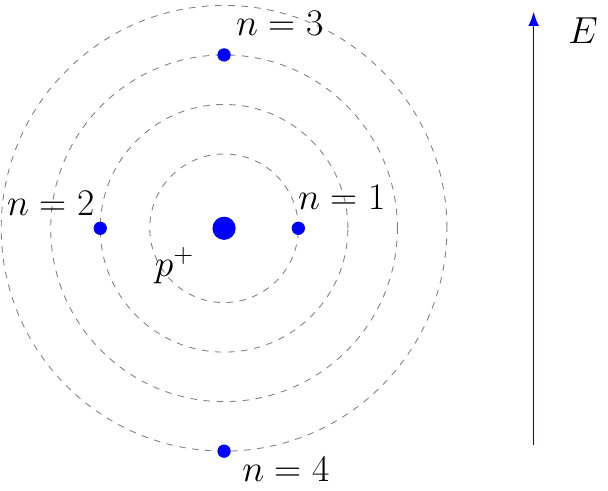
This formula calculates the allowed energy levels of an electron in the hydrogen atom according to the Bohr model. The model predicts that electrons can occupy only specific quantized energy states rather than any arbitrary energy.
The energy of each level depends on the principal quantum number. As the electron moves to higher energy levels, its energy becomes less negative, indicating that it is less tightly bound to the nucleus. The highest possible energy corresponds to ionization, where the electron is completely removed from the atom.
When to use it
Use this formula when studying the hydrogen atom, atomic spectra, electron transitions, ionization energy, and introductory quantum mechanics. It is also applicable to hydrogen-like ions that contain a single electron.
Example
Given:
Principal quantum number = 2
Formula:
Eₙ = -13.6/n²
Substitution:
E₂ = -13.6/2²
Result:
E₂ = -3.4 eV
This is the energy of the electron in the second allowed energy level of the hydrogen atom.
Applications
Atomic spectroscopy
Quantum mechanics
Hydrogen-like atoms
Electron transition analysis
Laser physics
Atomic structure studies
Physics education
Note
The ground state (n = 1) has the lowest energy of -13.6 eV. As the principal quantum number increases, the energy approaches 0 eV, which represents the ionization limit where the electron is no longer bound to the nucleus. Transitions between these discrete energy levels produce the characteristic emission and absorption spectra of hydrogen.