
\[R=\frac{Z_2-Z_1}{Z_2+Z_1}\]
Variables
Rreflection coefficient
Z1seismic impedance of upper layer (kg/(m²·s))
Z2seismic impedance of lower layer (kg/(m²·s))
Description
What is this formula?
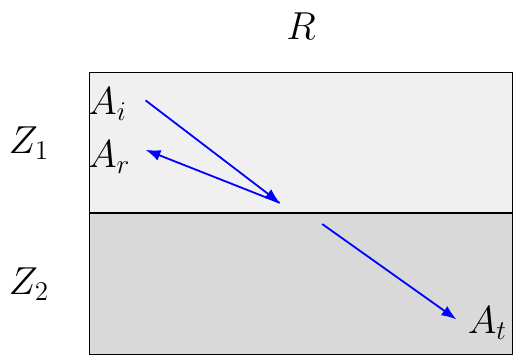
This formula calculates the seismic reflection coefficient for a wave striking an interface at normal incidence. It describes the fraction of wave amplitude reflected due to impedance contrast between two layers.
When to use it
Use this equation in seismic exploration and geophysics when studying wave reflections between underground geological layers.
Example
Calculate the reflection coefficient between two rock layers with seismic impedances of 8.5×10^6 and 1.2×10^7 kg/(m²·s).
Data:
Z1 = 8.5×10^6 kg/(m²·s)
Z2 = 1.2×10^7 kg/(m²·s)
Formula:
R = (Z2-Z1)/(Z2+Z1)
Substitution:
R = ((1.2×10^7)-(8.5×10^6))/((1.2×10^7)+(8.5×10^6))
Result:
R = 0.171
Applications
- Seismic reflection surveys
- Oil and gas exploration
- Subsurface imaging
- Acoustic boundary analysis
- Earth structure studies