
Variables
Description
What is this formula?
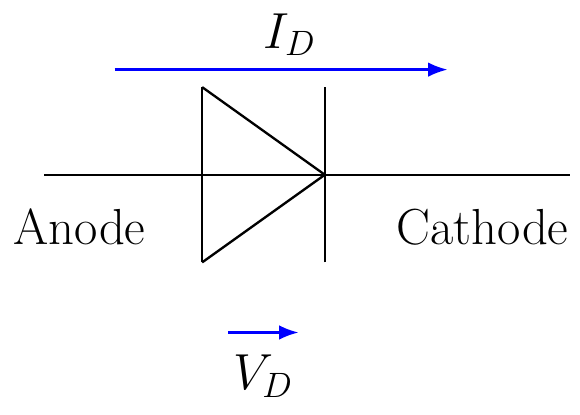
The Diode Shockley Equation models the current flowing through a semiconductor diode as a function of the applied voltage. It is the fundamental equation used to describe diode behavior in electronics.
When to use it
Use this formula when analyzing semiconductor diodes, rectifiers, LED circuits, switching electronics, or transistor junction behavior.
Example
A silicon diode has a reverse saturation current of 1 nA, an ideality factor of 1, and a thermal voltage of 25.9 mV. The applied diode voltage is 0.7 V.
Given:
Is = 1×10^-9 A
n = 1
Vt = 0.0259 V
Vd = 0.7 V
Formula:
Id = Is (e^(Vd/(nVt)) - 1)
Substitution:
Id = (1×10^-9)(e^(0.7/(1×0.0259)) - 1)
Result:
Id ≈ 0.547 A
The diode conducts approximately 0.547 A.
Applications
Rectifier circuits, LED analysis, semiconductor physics, transistor modeling, switching circuits, and analog electronics.