
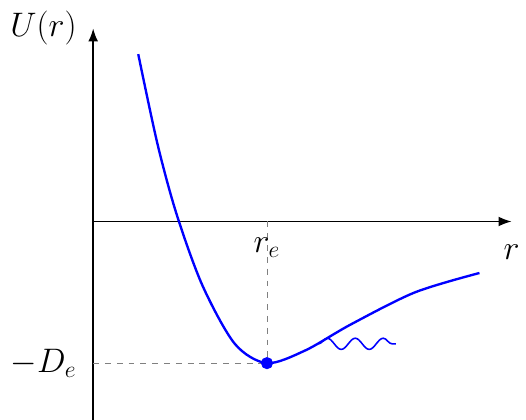
\[U=D_e\left(1-e^{-a(r-r_e)}\right)^2-D_e\]
Variables
Upotential energy (J)
Dedissociation energy (J)
apotential width parameter (1/m)
rinternuclear distance (m)
reequilibrium bond distance (m)
Description
What is this formula?
The Morse potential describes the interaction potential energy between two bonded atoms as a function of internuclear distance.
When to use it
Use this formula in molecular physics, chemical bonding analysis, quantum chemistry, and spectroscopy to model realistic atomic bond vibrations.
Example
A diatomic molecule has:
De = 4.5×10^-19 J
a = 2.0×10^10 1/m
re = 1.2×10^-10 m
r = 1.4×10^-10 m
Formula:
U = De*(1-e^(-a*(r-re)))²-De
Substitution:
U = 4.5×10^-19 × (1-e^(-2.0×10^10 × (1.4×10^-10-1.2×10^-10)))² - 4.5×10^-19
Result:
U ≈ -3.73×10^-19 J
The molecular potential energy is approximately -3.73×10^-19 J.
Applications
- Molecular vibration analysis
- Quantum chemistry
- Spectroscopy
- Chemical bond modeling
- Molecular dynamics