
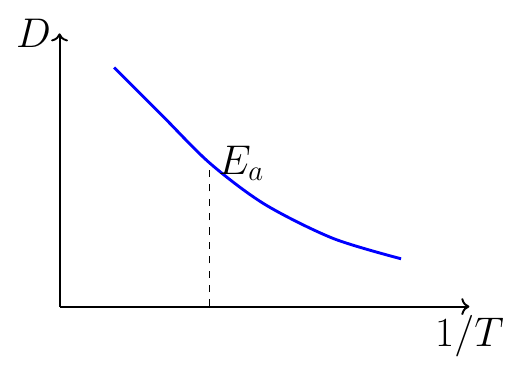
\[D=D_0e^{-\frac{E_a}{RT}}\]
Variables
Ddiffusion coefficient (m²/s)
D0pre-exponential diffusion coefficient (m²/s)
Eaactivation energy (J/mol)
Runiversal gas constant (J/(mol·K))
Tabsolute temperature (K)
Description
What is this formula?
The Arrhenius diffusion coefficient equation calculates how the diffusion coefficient changes with temperature due to thermal activation.
When to use it
Use this formula in chemical physics, materials science, solid-state diffusion, and thermally activated transport processes when diffusion strongly depends on temperature.
Example
Carbon diffuses in steel with:
D0 = 2.3×10^-5 m²/s
Ea = 80000 J/mol
T = 1000 K
Using:
R = 8.314 J/(mol·K)
Formula:
D = D0*e^(-Ea/(R*T))
Substitution:
D = 2.3×10^-5 × e^(-(80000)/(8.314×1000))
Result:
D ≈ 1.52×10^-9 m²/s
The diffusion coefficient at 1000 K is approximately 1.52×10^-9 m²/s.
Applications
- Solid-state diffusion
- Semiconductor fabrication
- Heat treatment of metals
- Atomic migration studies
- High-temperature materials engineering