
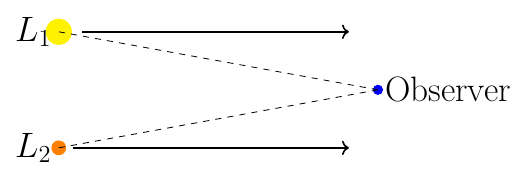
\[\frac{L_1}{L_2}=10^{0.4(M_2-M_1)}\]
Variables
L1luminosity of object 1
L2luminosity of object 2
M1absolute magnitude of object 1
M2absolute magnitude of object 2
Description
What is this formula?
This formula calculates the luminosity ratio between two astronomical objects based on their difference in absolute magnitudes. In astronomy, a lower magnitude corresponds to a brighter and more luminous object.
When to use it
Use this formula when comparing the intrinsic brightness of stars, galaxies, or other celestial objects using their absolute magnitudes.
Example
Star A has an absolute magnitude of 2 and star B has an absolute magnitude of 5.
Formula:
L1/L2 = 10^(0.4(M2-M1))
Substitution:
L1/L2 = 10^(0.4(5-2))
L1/L2 = 10^(1.2)
L1/L2 = 15.85
Result:
Star A is approximately 15.85 times more luminous than star B.
Applications
- Stellar luminosity comparisons
- Star classification
- Galaxy brightness studies
- Astrophysical observations
- Variable star analysis