
Variables
Description
What is this formula?
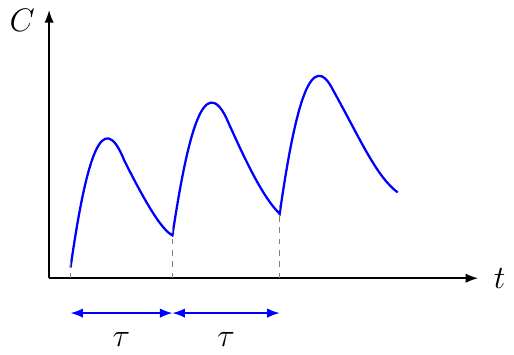
The multi-dose one-compartment concentration model estimates drug concentration after repeated administration of identical doses in a one-compartment pharmacokinetic system.
Each new dose is added before complete elimination of previous doses, producing drug accumulation.
As the number of doses increases, concentrations approach steady-state conditions.
When to use it
Use this formula when a drug follows one-compartment pharmacokinetics with first-order elimination and is administered repeatedly at fixed intervals.
It is commonly used in therapeutic drug monitoring, dose regimen design, pharmacokinetic simulations, and accumulation studies.
Example
A drug is administered repeatedly.
Data:
Dose = 500 mg
Vd = 50 L
n = 5
k = 0.15 h⁻¹
τ = 8 h
t = 2 h
Formula:
C = (Dose/Vd)·[(1−e^(-nkτ))/(1−e^(-kτ))]·e^(-kt)
Substitution:
C = (500/50)·[(1−e^(-5×0.15×8))/(1−e^(-0.15×8))]·e^(-0.15×2)
Result:
C ≈ 13.2 mg/L
Applications
- Repeated-dose pharmacokinetics
- Drug accumulation analysis
- Therapeutic drug monitoring
- Dose regimen optimization
- Pharmacokinetic simulations
Note
This model assumes instantaneous absorption, first-order elimination, constant pharmacokinetic parameters, and identical doses administered at regular intervals. More sophisticated models may be required for drugs exhibiting nonlinear kinetics, variable absorption, multicompartment behavior, or changing clearance over time.