
Variables
Description
What is this formula?
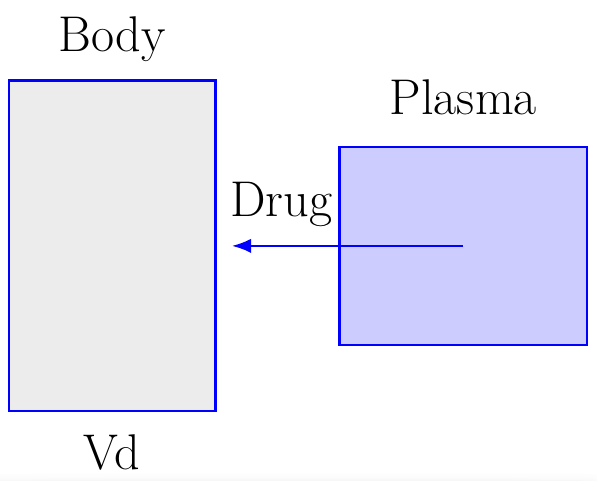
The volume of distribution is the apparent volume that would be required to contain the total amount of drug in the body at the same concentration measured in plasma.
It is a theoretical pharmacokinetic parameter that helps describe how extensively a drug distributes into tissues relative to the bloodstream.
A small volume of distribution suggests the drug remains mainly in the plasma, while a large volume of distribution indicates extensive tissue distribution.
When to use it
Use this formula when the total amount of drug in the body and the plasma concentration are known.
It is commonly used in pharmacokinetic analysis, loading dose calculations, drug development, and therapeutic drug monitoring.
Example
A patient receives a drug and the estimated amount present in the body is 1000 mg. The measured plasma concentration is 20 mg/L.
Data:
A = 1000 mg
C = 20 mg/L
Formula:
Vd = A/C
Substitution:
Vd = 1000/20
Result:
Vd = 50 L
Applications
- Loading dose calculation
- Pharmacokinetic modeling
- Drug distribution assessment
- Drug development studies
- Therapeutic drug monitoring
Note
Volume of distribution is an apparent rather than a physical volume. Values may exceed total body volume because the parameter reflects the extent of tissue binding and distribution rather than an actual anatomical space. Different pharmacokinetic models may produce slightly different estimates of Vd.