
Variables
Description
What is this formula?
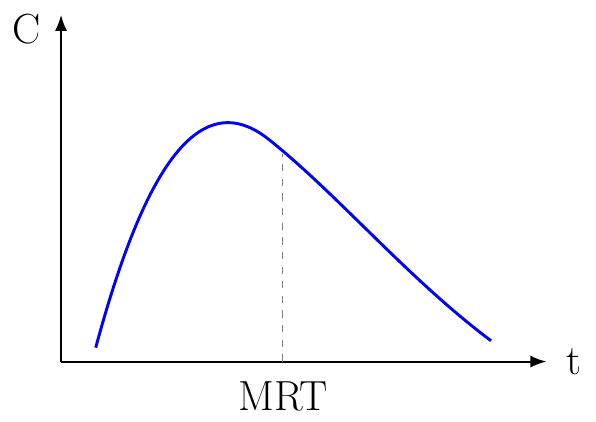
Mean Residence Time (MRT) represents the average time a drug molecule remains in the body after administration.
It is calculated as the ratio of the Area Under the First Moment Curve (AUMC) to the Area Under the Concentration-Time Curve (AUC).
MRT provides a global measure of drug persistence in the body and is widely used in pharmacokinetic analysis.
When to use it
Use this formula when AUC and AUMC have been determined from concentration-time data.
It is commonly used in noncompartmental pharmacokinetic analysis, drug development studies, bioavailability assessment, and comparison of different formulations.
Example
A pharmacokinetic study reports:
AUMC = 960 mg·h²/L
AUC = 120 mg·h/L
Formula:
MRT = AUMC/AUC
Substitution:
MRT = 960/120
Result:
MRT = 8 h
This means that, on average, drug molecules remain in the body for approximately 8 hours.
Applications
- Noncompartmental pharmacokinetic analysis
- Drug formulation comparison
- Drug development studies
- Bioavailability assessment
- Evaluation of drug persistence
Note
MRT is a model-independent pharmacokinetic parameter but depends on accurate estimation of AUC and AUMC. Different sampling schedules and extrapolation methods can influence the calculated value. For extravascular administration, MRT includes both absorption and elimination processes.