
Variables
Description
What is this formula?
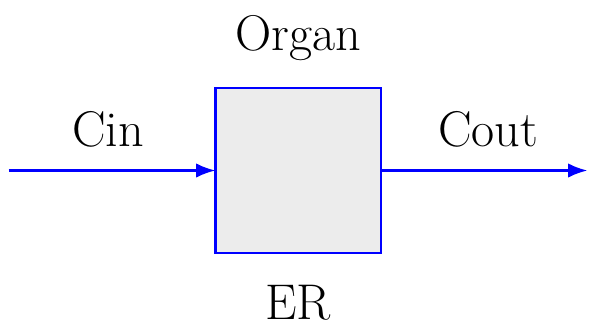
The extraction ratio quantifies the fraction of a drug removed from the blood during a single pass through an eliminating organ such as the liver or kidney.
Its value ranges from 0 to 1.
An extraction ratio near 0 indicates little drug removal, while a value near 1 indicates highly efficient extraction.
When to use it
Use this formula when drug concentrations entering and leaving an organ are known.
It is commonly used in hepatic pharmacokinetics, renal pharmacokinetics, drug clearance studies, and physiologically based pharmacokinetic models.
Example
A drug concentration entering the liver is 20 mg/L and the concentration leaving the liver is 8 mg/L.
Data:
Cin = 20 mg/L
Cout = 8 mg/L
Formula:
E = (Cin - Cout)/Cin
Substitution:
E = (20 - 8)/20
E = 12/20
Result:
E = 0.60
This means that 60% of the drug is removed during a single passage through the organ.
Applications
- Hepatic extraction studies
- Renal extraction studies
- Organ clearance estimation
- Physiologically based pharmacokinetic models
- Drug disposition analysis
Note
The extraction ratio is an observational pharmacokinetic parameter that may vary with blood flow, protein binding, enzyme activity, transporter activity, and disease state. High-extraction drugs are often flow-limited, whereas low-extraction drugs are more dependent on intrinsic metabolic capacity and protein binding.