
Variables
Description
What is this formula?
The Receptor Occupancy Equation calculates the fraction of receptors occupied by a ligand at equilibrium.
It is one of the fundamental equations of receptor pharmacology and is derived from the law of mass action for reversible ligand–receptor binding.
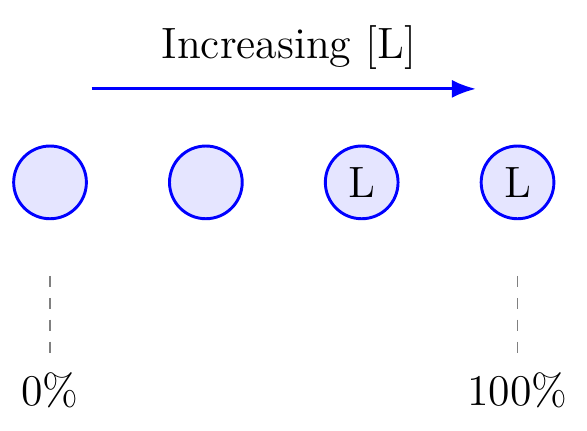
The result ranges from 0 to 1, where:
θ = 0 indicates no occupied receptors
θ = 1 indicates complete receptor occupancy
When the ligand concentration equals Kd, receptor occupancy is exactly 50%.
When to use it
Use this equation when:
- Studying receptor–ligand interactions
- Estimating receptor occupancy
- Comparing ligand affinity
- Modeling pharmacodynamic responses
- Analyzing binding experiments
Example
Given:
L = 20 nM
Kd = 5 nM
Formula:
θ = L/(Kd + L)
Substitution:
θ = 20/(5 + 20)
θ = 20/25
θ = 0.80
Result:
80% of receptors are occupied by the ligand.
Applications
- Receptor pharmacology
- Drug development
- Radioligand binding studies
- Molecular pharmacology
- Pharmacodynamic modeling
- Biochemistry
Note
This equation assumes reversible binding, a single receptor population, equilibrium conditions, and non-cooperative interactions. More complex receptor systems may require models incorporating cooperativity, allosteric modulation, receptor subtypes, or multiple binding sites.