
Variables
Description
What is this formula?
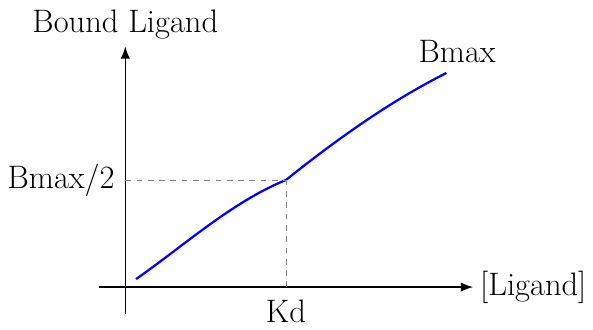
The Ligand Binding Saturation Model describes how the amount of ligand bound to receptors increases as ligand concentration rises.
As ligand concentration increases, receptor binding gradually approaches a maximum value (Bmax), reflecting saturation of the available binding sites.
The model is one of the fundamental equations of receptor pharmacology and biochemistry and is derived from the law of mass action.
When to use it
Use this equation when:
- Analyzing receptor binding experiments
- Determining receptor density
- Estimating Bmax and Kd
- Studying ligand–receptor interactions
- Evaluating binding saturation curves
Example
Given:
Bmax = 100 pmol/mg
Kd = 5 nM
L = 15 nM
Formula:
B = (Bmax × L)/(Kd + L)
Substitution:
B = (100 × 15)/(5 + 15)
B = 1500/20
B = 75 pmol/mg
Result:
The predicted receptor binding is 75 pmol/mg, corresponding to 75% of the maximum binding capacity.
Applications
- Receptor pharmacology
- Radioligand binding studies
- Drug discovery
- Molecular biology
- Biochemistry
- Affinity characterization
Note
This model assumes a single class of independent binding sites operating under equilibrium conditions. Real biological systems may contain multiple receptor populations, cooperative interactions, allosteric effects, or non-equilibrium behavior that require more advanced binding models.