
Variables
Description
What is this formula?
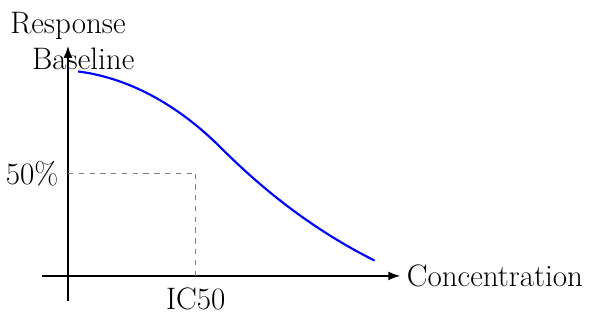
The Inhibitory Emax Model describes pharmacological responses that decrease as drug concentration increases.
Unlike the standard Emax model, which represents stimulation or activation, this model represents inhibition of a biological response, enzyme activity, receptor signaling pathway, biomarker level, or physiological function.
The response decreases from a baseline value (E0) toward a maximum inhibitory effect (Imax).
When to use it
Use this model when:
- A drug suppresses a biological response
- Modeling enzyme inhibition
- Studying receptor antagonists
- Quantifying biomarker reduction
- Performing PK/PD inhibition analysis
Example
Given:
E0 = 100
Imax = 80
IC50 = 5 mg/L
C = 10 mg/L
Formula:
E = E0 − (Imax × C)/(IC50 + C)
Substitution:
E = 100 − (80 × 10)/(5 + 10)
E = 100 − 800/15
E = 46.7
Result:
The expected response is approximately 46.7 units.
Applications
- Pharmacodynamics of inhibitors
- Enzyme inhibition studies
- Antagonist drug analysis
- Biomarker suppression modeling
- Clinical pharmacology
- Drug development
Note
The Inhibitory Emax Model is an empirical pharmacodynamic model. Depending on the biological system, inhibitory responses may exhibit sigmoid behavior requiring an inhibitory sigmoid Emax model with a Hill coefficient. Alternative formulations using fractional inhibition are also common in the literature.